The questions you must ask your buyers during a win-loss interview
02/08/2026Learn
Structuring a win-loss or buyer/ customer interview properly and asking the right questions is critical to success. When done well, a win-loss interview uncovers a plethora of information about a whole number of issues beyond the ultimate reason a deal was closed either won or lost. This article lists some of the critical questions that should be asked in order to gather the best insights.

- Asking the right questions is the key to insights which improve revenue
- The key questions to ask in every win-loss interview
- Other top tips
- Conclusion
Asking the right questions is the key to insights which improve revenue
Got a dashboard that lists won and lost reasons? ‘Lost due to X reason, won due to Y reason….’ This is useful from a reference standpoint, and perhaps leadership appreciates it from a reporting perspective, but does it actually drive revenue?
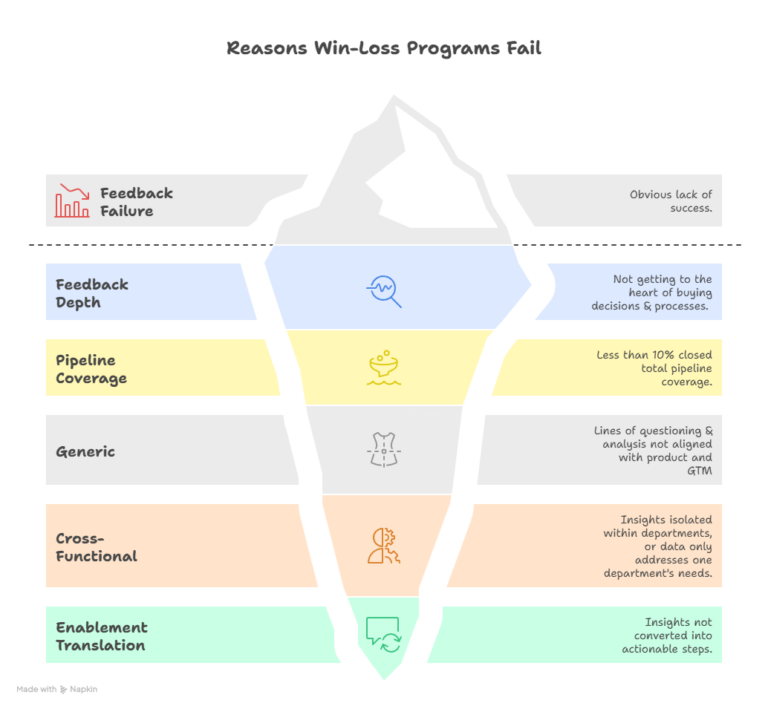
Does a dashboard tell you things about your buyers needs and processes that you didn’t already know? Does it tell you how to improve your product, your features, how you talk to customers? If your win-loss efforts are revealing the ultimate reasons for wins and losses but not much more, you’re leaving a whole tonne of vital information on the table! I’ve written in more detail about exactly what kinds of insights a good win-loss program should uncover here.
If you’re not capturing much more than the ultimate reasons for wins and losses, you’re leaving a tonne of vital information on the table!
Both the way you structure a win-loss interview – building rapport, proving for depth and detail at the right time – and the questions you ask are key here. Below is an outline of some of the important questions you should be asking in practically every debrief with your buyers, once the deal has closed.
Of course your discussion guide and questions should be heavily tailored to your product, the persona and the buyer’s company (i.e. the questions you ask a midmarket buyer will be different to those you ask an enterprise buyer, or one in Manufacturing in contrast to a Professional Services firm)… yet I believe there are some key questions that are beneficial to ask every single time.
Key questions to ask in every win-loss interview
“At what point did you realise you needed to go to market for a new X solution?”
Why?: Uncovers customer pain, key success metrics and strategic priorities.
When you ask this question, right at the start of an interview, it gets the buyer in the frame of mind for talking about their process and decision criteria, but it also uncovers how their pain with their incumbent solution or process was manifesting itself internally. For instance, did they see a decline in some kind of internal score, for instance related to productivity, efficiency, service desk tickets, some kind of quarterly internal survey or something else entirely? Those numbers
How was the buyer’s pain with their incumbent solution or process manifesting itself internally? Why was this pain so great that the buyer decided they had to throw money at it? This is absolutely critical fodder for your sales, marketing and product marketing teams.
Secondly, why was this pain so great that it led the business to decide they had to throw money at it? This will shed light on the key priorities and strategic challenges that your ICP is facing.
All of this information, especially if gathered diligently over time in combination with proper pattern-spotting, is absolutely critical fodder for your sales, marketing and product marketing teams. It is the foundation for conversations with new prospective buyers, your demand gen and account based marketing efforts, and the positioning and messaging your company adopts.
“How did you go about looking for potential providers?”
Why: Know how buyers find you and decide if you’re worth speaking to.
We’re talking about inbound leads here, of course, but let’s think about the importance of this question both for your pipeline and brand reputation, as well as how buyers view what your solution is and who it’s for. Asking this question frequently reveals some of the following:
- Where are buyers coming across your name? It it SEO/ GEO? Is it an Analyst report from Gartner or Forrester? Is it word of mouth or some other recommendation?
- Which sources are trusted by your ICP?
- Which other vendors were also on an initial longlist? Are they your typical competitors, or something else? That can give you some big clues as to whether this buyer was a good fit in the first place (and long term, can provide some excellent clues to your sales team can use to qualify deals in or out quickly).
- Did the buyer contact vendors in a particular order?
“How was the evaluation organized internally?”
Why: Understanding HOW your buyers typically buy.
You’ll be surprised at how little vendors often know about HOW their buyers buy. For example, did your buyer have a ‘shopping list’ of requirements in a big excel spreadsheet, weighted by priority (this is something you see quite a lot). Were they more informal and simply looked to schedule demos as quickly as possible?
Did your buyer have a ‘shopping list’ of requirements? How were these weighted or prioritized? Which stakeholders were involved and what was the chain of approval?
Key information this question reveals usually includes:
- WHO was involved internally? Who did your champion have to convince?
- What was the prioritization of features and requirements? How did your buyer come up with this? What was their logic?
- What was the sign off process? What hurdles had to be overcome? Who ultimately held the budget? (Hopefully your sales team already knew this but you’d be surprised!)
Ease of buying is a HUGE reason why buyers do or do not select a vendor…. Knowing as much as possible about your customers’ internal processes and preferred way of purchasing is your means of streamlining things and winning more deals.
“In a nutshell, what was the reason you did or did not decide to purchase?”
Why?: Isolate the biggest versus other contributing factors for the win or loss.
It’s important to ask the key question in this way because there will rarely be one single reason for a win or loss. Usually, it’s a combination of lots of factors; your job, as interviewer, it to work out which of those factors were surmountable, and which were not.
After this pivotal question is asked, you then use probing to dig deeper into why
There will rarely be one single reason for a win or loss. Your job, as interviewer, is to work out which of those factors were surmountable, and which were not.
“What was the real moment or feature or proof point that made competitor X look like the best solution for you?”
Why? Find out how and where your competitors are hurting you.
Often, lost deals are lost to competitors, whether you know it or not. It’s common to find out in the course of win-loss interviews that a competing solution was selected in the end, even if your AE didn’t know this and didn’t know enter it as the loss reason in your CRM.
If your lost buyer tells you they ended up purchasing another solution instead, your priority should be finding out why. Questions such as the above encourage your buyer to think back over what the competitor did, showed or told them that really resonated and convinced your buyer that they were a better fit than what you offer. This question helps to pin down exactly why made the difference and how your competitors are hurting you.
Because you can do all the research and Competitive Intelligence work in the world… but what’s truly important is what your competitors are doing that elevate their offering (and, sometimes, downgrade yours) in the eyes of your buyers.
How did you justify the expenditure on a new solution? How could we have helped you to build a business case?
Why? Know how to arm your champions to sell internally. Increase deal velocity.
This gets away a little from the reasons at the heart of a win or loss, but it will certainly help you win more deals in the future.
Many B2B deals start with champions, rather than the person that gives the final ‘yes’ or the person holding the purse-strings; you’re at least twice as likely to close a deal by helping your internal champion sell to others. As such, I often get asked by Clearsighted’s clients to tease out how key champions build business cases internally and how they justify expenditure on a new solution before it passes ‘up the food chain’ to c-suite.
Your buyer will be basically telling you what you need to do to improve sales velocity and accelerate time-to-close.
Whether a deal has closed won or lost, ask your champion how they justified the expenditure in the first place (assuming of course that the deal made it to qualified pipeline) and if there was anything that you could have done, or provided your champion with, that would have helped them to sell internally. This will give you yet another crucial window into your buyers’ internal processes, what metrics or success criteria they use, and what levers really move things in your buyers’ eyes. Your buyer will be basically telling you what to do to speed up the sales process and accelerate time-to-close.
What will success look like for you?
Why?: More success metrics, PLUS vital info for your implementation and customer success teams.
Ask this question at the end of the interview regardless of whether you won or lost the opportunity. Obviously, it’s another great revealer of what really matters to your buyers and what outcomes they’re ultimately looking to drive with a solution like yours.
But there’s another very good reason to ask this question… Handovers between the AEs who fought for the signature on the contract and the following implementation and then customer services teams – the ones who set everything up and ensure the customer actually gets what they need out of your solution – can be fraught and tricky. In fact, many implementations can prove a sticking point and an early bump in the road that sets the tone for the relationship going forwards. Getting a very early, very clear direction of the customer’s must-haves and priorities is a great advantage.
Don’t just rely on the pain points uncovered by sales during Discovery… give your Implementation/ Professional Services and then your Customer Success Managers (who, by the way, I think always have the toughest job!) a headstart with some golden nuggets of information. Your company’s renewal rate may thank you later.
Other top tips
Always make it about the buyer
If you look again at the questions above, you’ll notice that they’re very buyer oriented. That is, they always ask questions in a way that shows the whole conversation is about the buyer and their experience, and not about you.
It’s worth pointing out too that if you go about conducting win-loss interviews in a buyer-centric way, you’ll leave a good impression. If the deal was won, this may help solidify in the buyer’s mind that you were the right choice. If it was lost, a positive conversation with you may well be remembered and they may come back when the contract is up for renewal.
Sometimes, silence is golden
Don’t be too keen to interject, prompt the interviewee, or to move on to the next question. Many of these questions take thinking time, and it’s almost always a good idea to let an answer rest for a moment.
Don’t be too keen to fill the space. State the question simply and clearly, then allow your buyer to think about their answer without you filling the pause.
Don’t be afraid to ask for more detail or clarification
Sometimes, a buyer will give a short answer to a question. Don’t be put off by this; as long as you don’t come across as ‘pushy’ or dissatisfied an interviewee will almost always respond to further probing. Often, something as simple as these is effective:
- Would you mind giving me more detail on that?
- Sorry, could you explain what X is/ means?
- Do you mind telling me why XYZ?
Take notes and ‘circle back.’ It shows you’re listening
Sometimes, a buyer will be in the ‘flow’ of their thoughts and you don’t want to interrupt. This is good – allow the conversation to continue in the direction which is top-of-mind for the buyer and for things to unfurl naturally. But, you must take notes by hand as the buyer’s speaking – even if you have an AI notetaker or transcription running – because it allows you to jot down things which will need to be unpicked.
Later in the conversation, at a point where it makes sense, you can say something like: “Earlier, you told me that XYZ. Can we circle back to that? I’d like to understand a little more about why that was critical to you at the time etcetera etcetera…” This makes sure you’re unpicking all the key themes. Buyers won’t mind being asked to retrace their steps and it actually shows that you’re listening to what they say.
Yes, AI notetakers exist. But please, take notes by hand because it gives you a chance to unpick the conversation as you go along and return to key points later, when it makes sense to do so.
Conclusion
Conducting good win-loss interviews that uncover the full range of insights on offer from buyers is a skilled and diligent process that requires proper thought and preparation.
Of course, discussion guides should be tailored to whoever you’re speaking to, but even if you only ask the questions in this article, you’ll be on the way to gathering valuable insights and avoiding some of the common mistakes that win-loss programs can make.