
Why do win-loss programs fail? A look at the key reasons, plus how to fix things.
Setting up some kind of win-loss feedback loop is one thing, but having a program that consistently delivers high quality, actionable insights is another challenge entirely. In this article, we look at some of the common reasons for failure, plus what you can do to turn your program around.
- The challenge of successful win-loss
- Surface-level feedback from buyers
- Lack of overall pipeline addressed
- Lack of tailoring to your product, company or GTM
- Insights are not shared cross-functionally
- Insights are not translated into enablement
- Checklist for ‘good win-loss’
The challenge of successful win-loss
Setting up a win-loss program is a strategic, high visibility activity in any organization. It’s also one that’s resource intensive, requires a lot of consistency and diligence, and is highly skilled. But, if done well, it can have a huge impact on a variety of metrics from win rates to seller confidence and revenue growth. It is also an activity that overwhelmingly has a positive ROI.
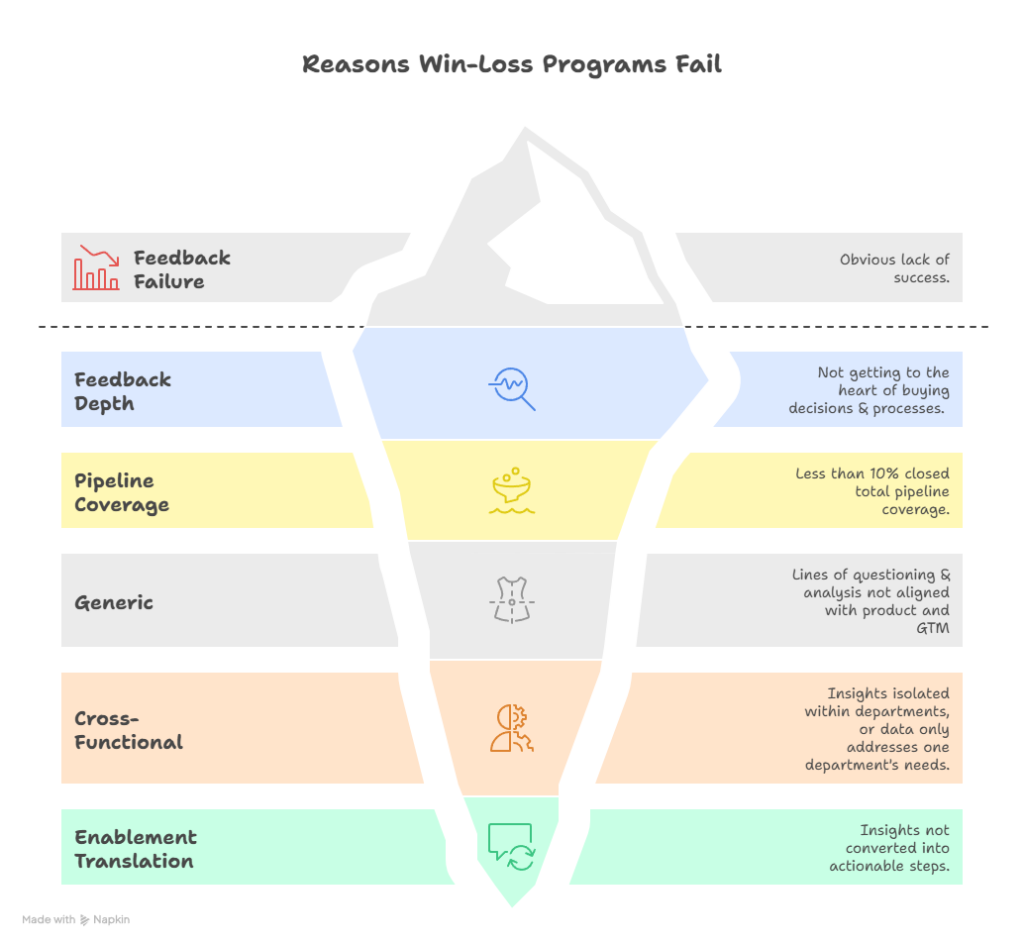
However it can, and sometimes does, fail to deliver the results required – or simply falls below expectations. From over 15 years of conducting end-user research and running successful in-house win-loss programs, plus from speaking to loads of PMMs and revenue leaders day-to-day, I would say the following reasons are the ones I encounter most commonly for win-loss programs failing:
- Lack of depth in end-user/ buyer feedback.
- Lack of overall pipeline addressed (i.e. you’ve gathered only very small part of the overall respondent feedback available).
- Lack of tailoring to your product, company and GTM.
- Insights are not shared cross-functionally.
- Insights are not translated into enablement.
Let’s take a look at each of these separately:
Surface-level feedback from buyers
I’d say this one is predominantly down to skill, plus determination to really get to the bottom of why your interviewee did or didn’t buy.
The fact of the matter is that it’s easy for buyers in lost deals to say simple things like “you were too expensive” or “we were looking for a company that offered XYZ feature.” Your job as an interviewer is to get to the bottom of and unravel these objections. For example, was there a set budget in mind, or what did other vendors quote? Why were XY and Z features business critical, or what else could the Sales Engineering team have demoed or explained?
Here are some suggestions to get past this:
- Prepare! Have an interview plan or discussion guide at the ready, tailored to that buyer persona. This includes how questions will ‘flow’ from one to the next, and areas where you should probe.
- Warm up and build rapport. Buyers are humans, just like you!
- Show you’re actively listening rather than just reading from a script (never, EVER just read from a script!).
- Question and probe actively. Think “you said earlier on in our chat that XXX, how does that link to the pricing discussions you had internally?” Obvious curiosity and active listening encourages respondents to open up, because they can see their feedback is being valued.
- Don’t just take X for an answer if it sounds unusual, or like there may be more. A simple “why?” or “do you mind unpicking that for me?” can go a long way.
It’s impossible to get a good amount of depth in a mere 30 minutes. Good win-loss interviews need to be 45mins or more in length, especially for complex enterprise deals.
Something I’d add here is that personally, I think it’s impossible to get a good amount of depth, plus the warming-up and laying-the-groundwork for a proper discussion, in a mere 30 minutes. Good win-loss interviews need to be 45mins to an hour in length, especially for complex enterprise deals.
Lack of overall pipeline addressed
An email or survey or the odd interview here and there just doesn’t cut it; getting feedback from 10% of your total closed pipeline is critical. Remember, we’re aiming for interviews, but where these aren’t possible a survey or even some quick feedback via email is better than nothing.
If you’ve engaged an external win-loss partner and are still having to chase up interviews and feedback yourself, this is a sign things are going awry.
Here are some suggestions to get past this:
- Approach it like a benefit for the interviewee; their feedback will ultimately help your company to offer a better product or service to meet the needs of customers like them.
- Everyone’s busy! Offer an incentive to show you value their time. Not a $50 gift voucher (that’s a bit rubbish). Certainly a three figure incentive or a donation to a cause of their choosing.
- Follow up. For Clearsighted, that’s typically three times – no more, because that’s spammy. We try an email, an Inmail then a cold call.
- Be flexible. Sounds obvious, but you may sometimes need to make time in your diary. Show them their time matters to you.
- Opportunities that have closed far down your pipeline are the ideal target, but be prepared to reach out to others that didn’t make it that far (a good win-loss program should account for this anyway). It’s always worth speaking to opportunities that didn’t make it past RFP, for instance. Cast your net wide.
Remember, external agencies do tend to have a better hit rate than in-house win-loss teams, and closed won is usually easier to secure. At Clearsighted we have a 34% hit rate on closed lost, but the industry norm is more like 20%.
Lack of tailoring to your product, company or GTM
This is an area where in-house win-loss practitioners have a real advantage, as they already know the product and the company’s direction.
If you’re using an external provider or win-loss agency, there is absolutely no excuse for this. The fact is that one-size-fits-all win-loss just does not deliver insights that are unique to you and your company. Here are some general suggestions:
- Have a few different discussion guides or lines of questioning at the ready. It’s obvious that the needs and priorities of a technical buyer (think CIO) will be very different to those of someone in HR – don’t treat them the same.
- Make sure you know your product! For external agencies, this should involve watching demos where possible to get educated on features and functionality.
- Keep your fingers on the pulse of product updates (yours, plus competitors’) so you can pivot to ask questions about these where necessary.
- Keep dialogue between different teams strong – sales, product, revops, marketing – so you’re always ready when an opportunity for probing arises.
It’s obvious that the needs and priorities of a technical buyer will be very different to an HR leader – don’t treat different personas the same.
Insights are not shared cross-functionally
Win-loss must be a cross-functional undertaking in order to drive maximum ROI. If you or a provider are only really serving the needs of one department (often this is Sales), you’re missing a huge part of the total value. I recommend:
- Setting up clear expectations for win-loss, and re-evaluating this regularly (probably biannually). A win-loss charter, outlining the needs, expectations and types of information from each stakeholder dept can be useful to keep you aligned.
- Think about how, and how often, win-loss insights will be shared. It’s a good idea to have a quarterly cadence of win-loss feedback in the form of an executive presentation outlining key trends and learnings/ recommendations from that period of interviews, plus have the raw data ready to view at all times by anyone that wants it. The raw data can be housed in an app, a folder, or an AI tool such as Notion or Notebook LM.
Insights are not translated into enablement
Someone once said to me “insight without enablement is just expensive research.” That’s certainly true with win-loss; win-loss data should be the absolute bedrock of all the competitive and sales enablement that Product Marketers and CI professionals do. Here are some some top-level suggestions about enablement related to win-loss research:
- Have a regular cadence of enablement. This can be purely win-loss, picking out some impactful verbatims from customers around their perception of the product or sales process or how they felt the demo could have been improved. GTM teams tend to lap up this kind of information and hearing customers’ perspectives directly really makes enablement stick.
- Make sure there are clear, succinct and easily accessible assets linked to the enablement you do – typically battlecards, playbooks, customer-facing decks or case studies. Being overt about the fact that win-loss goes into these assets and they are updated regularly helps sellers refer to them with confidence.
Checklist for ‘good win-loss’
There are multiple reasons why win-loss programs fail, or just don’t deliver the benefits and ROI that they should. When done well and consistently, win-loss really is one of the most impactful investments your B2B business can make.
To help determine whether your win-loss program is heading in the right direction, you may want to ask yourself the following:
- Are there clear gaps in the win-loss data I have? For example, is it missing crucial things like pricing, competitor insights, views on features/ functionality or feedback on key aspects of the sales process?
- Is the win-loss data I have lacking nuance? For example, does it lack clear differences and recognizable patterns between segments, verticals, geographies or different buyer personas?
- Am I getting short interviews or partially complete surveys? Am I having to send out emails to respondents, saying something like “can you give us more detail on X?”
- Am I getting less than 10% of my closed pipeline (either won or lost) in interviews?
- Is the data I’m getting heavily skewed towards the more ‘easy to get’ i.e. wins only, with little data for losses?
- Am I getting ‘journalistic soundbites’ rather than insights that direct the business towards clear actions to improve win rate?
If you’ve answered ‘yes’ to more than one of these, chances are your win-loss program is not reaching its full potential and it may be time for a rethink.