8 reasons buyers won’t tell Sales the truth (and why Sales should never own win-loss)
Account execs are the people actually selling your product and they already have a relationship with buyers. So wouldn’t it make sense for sales to also gather win-loss feedback? Actually, it’s the very opposite – sales should never conduct win-loss. This article looks at why.

- Why buyers will rarely tell salespeople why the deal was really lost
- Buyers don’t want to hurt anyone’s feelings
- Your salesperson is a seller, not an interviewer
- Your salesperson will be biased
- Why win-loss shouldn’t be left to Sales
- Neutral third parties have better interview rates
- Let your AEs focus on selling
- Sales are not product experts
- Win-loss debriefs with AEs only miss vital buyer insights
- Other top tips
- Conclusion
Why buyers will rarely tell salespeople why the deal was really lost
Sales absolutely must be a key stakeholder and cheerleader for any win-loss program. After all, win-loss uncovers critical information about sales execution and relationship building, pricing and commercial terms, demo effectiveness, and how your AEs’ approach landed (or did not land) versus your competitors’. As such, at Clearsighted we always get a CRO, VP Sales or other senior sales stakeholder involved with our win-loss programs from day one.
However, setting up a win-loss program can sometimes elicit some push-back from sales stakeholders. They can assume that you’re on a witch hunt, or that the responsibility for losses will be dumped on their doorstep. This is of course not true; almost always, the reasons for losses (especially in large, enterprise deals) are far more multifaceted than just being a sales failure, and any win-loss interviewer worth their salt is unbiased.
Nevertheless, anyone looking to start a win-loss program should hold their ground… sales should never own win-loss. I’d go as far as to say that they shouldn’t even send out emails asking for some ‘quick feedback’ (more on that below). Here are some concrete reasons why.
After a long sales cycle buyers don’t want to hurt anyone’s feelings
This is the top, number one reason why buyers will not tell your AEs the real reason behind that lost six figure deal… they’re just too nice.
Especially in long, complex enterprise deals where your champion, decision maker(s) and various other stakeholders spoke to your AE multiple times about everything from features to pricing to commercial and legal details – and your diligent AE answered that SMS at 10pm on a Friday night – your AE and buyer have built up a relationship. Even in lost deals, buyers see and appreciate the effort AEs have put in and the linebacking work they’ve done over the past six to eighteen months. This means they don’t want to hurt anyone’s feelings, or to come across as too negative.
Even in lost deals, buyers see and appreciate the effort AEs have put in and the linebacking work they’ve done over the past six to eighteen months. This means they don’t want to hurt anyone’s feelings, or to come across as too negative.
Also, because of the relationship that’s been built over this time, it prevents buyers from relaxing and opening up during interviews. With a salesperson they already know interviewing them, they’re noticeably more cautious, more tactful.
I have sat in countless “deal postmortems” with AEs and other senior sales stakeholders, where it’s just impossible to really dig in and get the truth. Vague answers like “the other vendor just went the extra mile” come out, and when the AE asks for detail the buyer shrugs their shoulders and says something evasive: “it’s hard to remember specific details.” Meetings like this are a waste of everyone’s time.
It’s far, far better to give the debrief to a neutral third party, where your buyer can really open up and get into the weeds of what happened, honestly and without fear of upsetting anyone.
Your salesperson is a seller, not an interviewer
Your salesperson’s job is to sell, not to interview (although of course you could argue that a very good discovery session has a lot in common with a win-loss interview!).
It’s surprisingly hard to do a really good human interview, and is a real skill honed over many years’ practice. A big, big reason for bringing a specialist win-loss agency on board is interview mastery; this especially pays off in sensitive, highly regulated or complex industries.
You should expect any win-loss provider to have conducted thousands of win-loss interviews and to be an expert at getting hard-to-reach answers out of human sources; this is why HUMINT specialism is so important. Win-loss providers should also handle everything from the preparation for each interview, to custom discussion guides, to conducting the interview in an unbiased way so as to surface unique insights and probe where needed. Salespeople are unlikely to appropriately structure and execute in-depth interviews; their job is to be great at selling, not human source intelligence.
Your salesperson will be biased
The biggest argument I have read and heard against sales doing win-loss interviews is that it would be akin to “marking your own homework.” This is a) Not the most pressing reason from what I’ve seen and b) Assumes sales want to cover their tracks and be sneaky in some way – which isn’t true. Actually, a better way of referring to it is thinking about the innate bias sales will have. Sales will see the deal as it happened from their own side.
There’s plenty of public data out there about the reasons for losses that AEs enter in CRMs being wrong 60-80% of the time. This is not because AEs are being dishonest, it’s because buyers have held things back from them during the sales cycle. Often, there are things going on internally, or conversations happening with competitors, that your Account Execs are just not privy to. Why then, would buyers magically disclose these things to AEs once the deal has closed lost?
Often, there are things going on internally [with the buyer], or conversations happening with competitors, that your Account Execs are just not privy to. Why would buyers magically disclose these to AEs once the deal has closed lost?
We conduct many won interviews here too at Clearsighted, where when you ask the buyer the ultimate reason they chose your client (vendor) without influencing that answer in any way, it will still be different from what’s in the CRM. Or, what’s in the CRM will be a contributing factor to the win but not the biggest factor that actually led the buyer to sign that contract.
It’s vital then, to be starting from a blank canvas without any preconceived ideas about what really happened in the deal.
Why win-loss shouldn’t be owned by Sales
In addition to buyers not telling salespeople the truth about why deals were won or lost, there’s also the below important points to consider:
Neutral third parties have better respondent recruitment rates.
For all the reasons stated above, neutral third parties such as Clearsighted or other win-loss specialists tend to have superior interviewee recruitment and completion rates. Buyers are usually happier to speak to someone that is not a part of the vendor’s business, because there’s a degree of separation between the feedback they give and the people and/or products that feedback is about. Negative feedback particularly can feel less severe if delivered to a third party, and buyers feel they can be more honest.
Often, win-loss providers also include incentives for interview participation as part of their recruitment process. For Clearsighted, this is a donation to a charity of the respondent’s choice, and included in the cost of all programs. It can feel easier for buyers to accept incentives coming from third parties (It’s always a good idea to check internal policies on corporate gifting and anti-bribery if you’re considering doing win-loss yourself and offering incentives).
Let your AEs focus on selling
I’ve never seen a sales org where AEs are expected to routinely collect buyer feedback – whether interviews, surveys, emails or something else – as part of their day-to-day. Usually, when requests for feedback for sales go out, it’s ad hoc and for the AE’s (or their boss’s!) own interest, rather than as part of a defined feedback loop.
Sales should be spending their time talking to leads and doing whatever work it takes to bring prospects closer towards closed won. This is a busy busy business, your AEs have tough targets, and there are only so many hours in the day.
Win-loss should not be on your Account Execs’ plate – but if it is, it should be taken off immediately so they can get back to selling.
Sales are not product specialists
I’ve seen sales blame product for losses and vice versa. These internal dynamics can unduly influence the questions and probing that happen during closed lost interviews in particular – and they exist to some degree in almost every B2B organization.
Saying “we lost due to X missing feature” can feel like a get out of jail free card for sales. Indeed, it often is part of the truth, but only part. Are you sure that salespeople will then ask critical follow-up questions, like why that particular feature was so important, why it couldn’t be overcome, or why something it was sub-optimal? Can you be sure that sales will challenge or push back on things the buyer says when needed?
I’ve written many times about how vital it is that win-loss programs are cross-functional. With sales doing win-loss interviews, this will not be the case.
Doing win-loss debriefs with your AEs only and not with your buyers misses vital insights
Some companies like to interview AEs after a deal has closed won or lost to get their perspective. Some companies even think this constitutes a win-loss program; it does not. This is a continuation from the point above about sales execs being inherently biased.
I think sales debriefs can be useful insofar as they help companies understand what did or did not work well during the sales cycle – after all, sales is a team effort. For instance, who stepped up to help AEs provide evidence or build relationships, or where were there disconnects?
But remember, the feedback that makes the most different to whether you win or lose deals is from the people who actually decided whether or not to sign on the dotted line and spend money on your product/ service: your buyers.
Other top tips
‘Quick feedback’ emails can scupper your chances of a more in-depth discussion
In the section above, I mentioned AEs requesting feedback in an ad hoc manner via email. If you’re thinking about a proper win-loss program you should discourage this because when it happens, buyers will typically not then want to spend the best part of an hour talking to you about what they believe they already told an AE in a few bullet points.
I hear the same thing about AI-conduced win-loss interviews. If a buyer gives you 5 minutes of feedback, they consider the job done and are not keen to hop on a call to provide detail and specifics.
Typically, you only get one chance to engage buyers in a meaningful way once a deal has closed. Don’t scupper it by sending out “quick feedback?” emails which won’t tell you anything you didn’t probably already know.
… but salespeople can help set up or introduce win-loss interviews for you
Sometimes it can be good practice to have the AE introduce you to their customer after the deal has closed, even though they won’t play a part in the actual interview. These warm introductions can help boost response rates, especially in regulated or sensitive industries, as it confirms the request is legitimate. Also, if the AE built up a solid relationship with the buyer, even if the deal closed lost, the buyer might feel that giving feedback is part of their ‘duty’ to the AE for a job they did well. This sense of obligation can help you get your foot in the door for a debrief.
In any case, you should always check with AEs whether a prospect is ok to contact, even after the deal has closed; sometimes sales and RevOps do a pipeline clean up and you don’t want to get in the way of a potential sales re-engagement.
One-on-one is best
Sometimes, too many cooks spoil the broth. This is certainly the case with win-loss interviews, where a one-to-one conversation beats one with a group every single time.
This is because it’s easier to keep a conversation on track and to probe deeply with just one voice to manage. I’d also say it’s human nature perhaps to be more honest and less self-conscious when you’re speaking to just one person, whose full attention you have.
Multithreading win-loss interviews within a single account is often a prudent idea with large, complex, enterprise deals; it ensures you gather deep feedback from different personas which can be corroborated and compared, to get a more complete picture of what happened in the account.
Things tend to get messier – and broader, rather than deep and detailed – when there are lots of voices in the mix, all with their own perspectives and opinions. I’ve seen this many times, and it’s why multithreading win-loss interviews within a single account is often a prudent idea with large, complex, enterprise deals; it ensures you gather deep feedback from different personas which can be corroborated and compared, to get a more complete picture of what happened in the account.
I’ve also seen, on more than one occasion, an entire senior leadership team quiz two exec buyer stakeholders on why a very large deal was (unexpectedly!) lost at the final hurdle. This is not the best approach. Buyers are not going to be honest in this situation, and you run the risk of leaving a bad impression for the future; who wouldn’t feel put upon if five or six C-suite from a vendor you had not selected wanted to interrogate you?
Conclusion
I can say from experience that there is absolutely, never ever, any reason why a win-loss program owned by Sales will be better than one owned by Product Marketing. Let’s recap, in very direct terms, on the reasons listed above why Sales should not do win-loss work:
- After 6-18 months talking, selling, fielding requests and negotiating, your buyer has respect for your AE and is too nice to tell them the real truth about why that big deal was lost (whether that’s the AE’s fault or not!).
- Your salesperson is an expert seller, not an expert interviewer. Human Intelligence is a particular skill, honed over many years’ experience.
- Salespeople are too close to the deal, and will usually ask questions that affirm their own biases.
- Neutral third parties (like Clearsighted) have better interview recruitment and completion rates.
- Your AEs are already too busy trying to close deals. Don’t give them the task of gathering buyer feedback too – it’s not an efficient use of time and not worth the results they’ll get.
- Win-loss must be cross-functional. It should be owned by someone who will give an equal stock to product issues as to sales issues as to pricing issues as to messaging issues etc etc etc.
- Deal debriefs with AEs are not very valuable. They tend to re-cite what’s already in your CRM, while your buyer might have a totally different perspective.
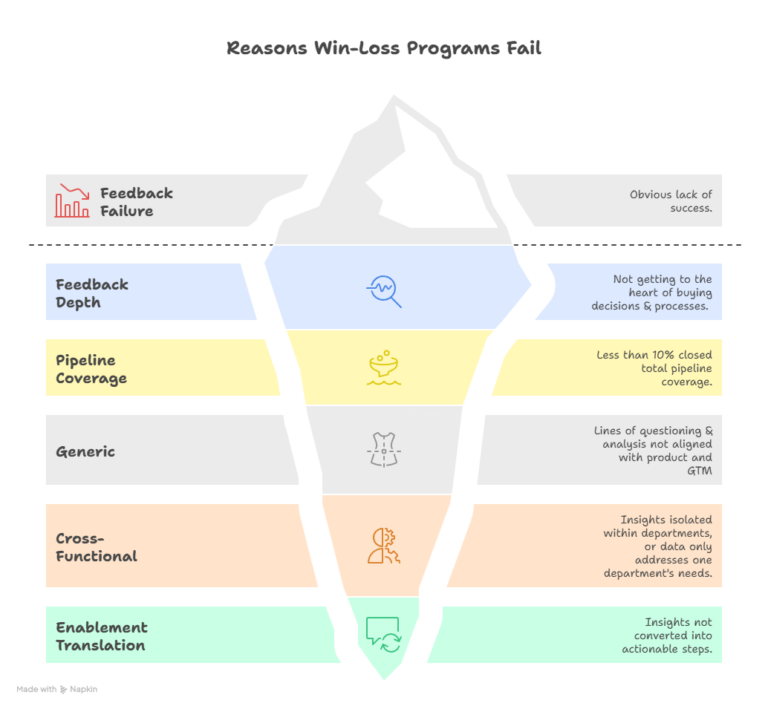
If you’re looking to avoid other common win-loss pitfalls, this article may be useful.
If you’re thinking about doing your own win-loss in house and don’t know what good results look like, or if you’re not sure that your current provider is capturing the breadth and nuance that they should be, you can use this article as a checklist.