What is win-loss analysis? a practical guide for B2B SaaS leaders (with real examples)
Win-Loss Analysis has gained more attention in recent years. This article outlines clearly what it is, why companies need it, who should be involved and the kind of insights you should expect.

- What is win-loss and why do you need it?
- Who should be involved in a win-loss analysis program?
- The insights good win-loss programs uncover – with some real examples
- Common win-loss pitfalls
- Outsourced vs In-house win-loss
- The current win-loss market
What is win-loss analysis and why do you need it?
What is win-loss? In simplest terms, it is:
Systematically gathering feedback directly from end-users and buyers about why they did, or did not, decide to purchase you. What I specifically mean is interviews with buyers and decision makers, and some surveys added in where an interview was not possible.
Having a win-loss program is crucial because it helps you understand what your customers want to see, hear and experience in order to spend money; it helps you refine everything from your product, to your GTM strategy, to how your sales and marketing teams talk to target customers. This is why win-loss is proven to increase win rates and revenue.
Win-loss is crucial because it helps you understand what your customers want to see, hear and experience in order to spend money; it helps you refine everything from your product, to your GTM strategy, to how your sales and marketing teams talk to your customers.
Sounds simple, right? Yes, it’s a simple concept – but purchasing decisions are never black and white; they’re often nuanced, with multiple stakeholders involved and considerations from functionality to pricing to reputation and sales experience. A good win-loss program needs to uncover these insights! This is why it is far more than a little 15 minute debrief over Zoom after a deal has closed, or an email from the customer to the effect of ‘thank you for your time, but we chose not to proceed because of XYZ.’ Also, in my opinion (and I know I’m not alone) Sales should never, ever own win-loss. I’ve written about why that is in more detail here.
I’d add to this that a strong win loss program needs to be done skilfully, be consistent (that is, gather insights across enough of your total closed pipeline as well as in substantial depth), and be executed with the support and backing of different teams across the organization. Missing out any of these elements can mean you’ve got a program which only delivers a fraction of the value it could, or which fails to deliver completely.
There’s some good data on the importance of win-loss being sustained and consistent. Gartner, Accenture and Deloitte have published studies on this, with Gartner claiming that a win-loss program of 24 months or more typically has a positive ROI of 84%.
It’s a bit of a shame then that many mid-size and large B2B SaaS vendors still do not have win-loss programs – or, do a little bit of ad hoc win-loss, only addressing a small proportion of their pipeline or just when a particularly important deal has been lost or won. It also should probably be pointed out that win-loss practices in EMEA B2B SaaS firms are generally a little behind their North American counterparts. This may be why the largest and most well-marketed win-loss providers and based in the U.S. and Canada.
Who should be involved in win-loss analysis and why?
I’ll keep saying this until the cows come home… win-loss must be a cross-functional undertaking. That is, multiple different stakeholders from different parts of the business should feel they have a seat at the table and are regularly receiving pertinent information from it.
Having said that, these days win-loss is most usually owned by either Product Marketing or Competitive Intelligence. Occasionally it is owned by Sales or RevOps. Whichever, the program owner is responsible for either running the program themselves and actually conducting interviews (if in-house), or for managing the program – including evaluating program quality – if outsourced to a third party provider.
So while Product Marketing or CI often owns the day-to-day running of the program and acts as a conduit for the insights that are uncovered, the insights themselves need to be fed back to different functions within the business and acted on appropriately. This is why it can be a very good idea to come up with a win-loss charter, a document which outlines each function’s needs and ideal outcomes from a win-loss program.
Win-loss should be a cross-functional undertaking. A win-loss charter, which outlines each function’s needs and ideal outcomes from a win-loss program, can be good practice.
I’ll give some examples of the different stakeholders who have an interest in win-loss, and the high-level things they’re keen to understand:
Product Marketing
‘How can I effectively differentiate our offering so that the value we provide for buyers is clear and provable?‘
Fundamentally, PMMs need to be experts on buyers and customers. The information gathered from win-loss is a critical input into positioning and messaging exercises, as well the business’s understanding of how to adapt to meet the needs of different personas and use cases. It’s also an absolute necessity for sub-roles in the PMM team, like Competitive Intelligence Managers, and it critical for effective enablement.
Sales
‘What can we do to win more deals and increase revenue?‘
Win-loss uncovers the real, unbiased reasons you’re winning and losing deals. It uncovers whether the way your teams are speaking to customers about your offering is effective, or holding you back. It uncovers patterns between your top and less successful sellers. It also uncovers how customers think you compare to competitors, and the value-adds competitors are offering that your revenue teams may not be aware of. All these reasons, and more, are why win-loss is proven to increase win rates.
Product
‘What features do our customers actually buy us for? What features are missing?’
It can be incredibly difficult to align ARR in new opportunities to features, and product teams need to know which features are moving the needle in deals, and where the gaps really are – from the buyer’s perspective. Win-loss data can be even more useful than other vital customer inputs into the roadmaps – such as Customer Advisory Boards (CABs) – because it gives you a real-time view of what your customers expect and what your competitors’ roadmaps look like.
Presales or Solution Engineering
‘How can we make demos and technical conversations more effective?‘
Sometimes, you can have the best product in the market and a customer that slots perfectly into your ICP… excect something goes wrong with the demo. Most of the time when this happens, SEs or Presales think everything has gone well, but you may hear something like “the demo showed us too many features” or “it didn’t really align with the problems we’d discussed during discovery.” It’s crucial to identify areas where your buyers were hoping to see something else, and to understand what you can change to make your demos land.
RevOps
‘How can I ensure our sales processes, the data captured in our CRM and reporting is accurate?’
It’s amazing how often the reason a buyer gives for a win or a loss – particularly a loss! – does not match the reason entered in your CRM. As this data is critical to pattern spotting, forecasting, board reporting and other predictions. Win-loss also helps with the accurate structuring of pipeline data and stages (for example, when should a deal really be qualified?), since it uncovers detail about customers’ internal decision-making processes. RevOps should get behind win-loss… your board and investors will thank you for it.
Sales and GTM Enablement
‘How can I educate reps to be more effective sellers and help them to close more business?‘
Having the evidence-based backing of win-loss data means that areas for improvement or where you should capitalize are clear. It also means that enablement actually lands. There’s no doubt that training sessions and materials, such as battlecards, playbooks etc are far more powerful when backed by verbatims and evidence from real customers.
Marketing
‘How can I build campaigns that actually capture buyers’ interest and move them down our pipeline?‘
Understanding your buyers’ needs and triggers to go-to-market for a new solution is vital to executive effective content, events, campaigns, and generating MQLs. Win-loss gives you a window into how your customers found you in the first place, where your customers are going to evaluate you, and your market reputation. It may also reveal new lead gen sources you weren’t aware of.
Customer success
‘What can we do to prevent customer churn?‘
Adding customer churn interviews into your win-loss program is always a smart move; no company can grow its ARR without improving its customer retention score. Often, customers leaving an existing vendor who they’ve been with for at least three years is a big decision – wouldn’t you like to know what it was that made the relationship untenable, or conversely why other solutions on the market were seen as worth leaving you for?
I’ll add as a final point that win-loss is a highly visible activity, and something that executive leadership, your board and your investors (if you have them) will usually be very interested in. All the more reason to do it well!
The insights good win-loss programs uncover – with some real examples
There are some categories of insights that a properly executed win-loss program should consistently uncover (I’ve also written about this in a lot more detail). I’l list 6 key ones here:
Customer pain
- What drove them to market?
- What metrics are they trying to influence?
- Why is this a strategic priority?
- Why now?
Example: “We needed to consolidate data across multiple systems because it was losing us X hours a quarter searching for that information.”
Customer process:
- Which stakeholders are involved and what does each need to see?
- What is their evaluation criteria (e.g. scoring matrix, TCO model)?
- How can you help them to buy?
- Which other vendors are they evaluating?
Example: “We formed an internal buying committee and nailed it down to twenty features. Ten of these were must-have, the others were nice-to-have. We then made up a spreadsheet with a scoring matrix and evaluated each of our shortlisted vendors’ demos against each feature, giving them a score from one to five.
Competitor tactics:
- What are competitors saying about you?
- How do competitors claim they’re different?
- What ROI or USP proof points do competitors provide?
- What value-adds do they offer?
- Who do they involve in deals?
Example: “X competitor offered us a free implementation on their white glove service. This really eased our fears about change management and convinced us that they wanted to be a good partner to us after the contract was signed.”
Competitor product:
- How did they demo?
- What features do they push?
- Where are their gaps vs you?
- How do they tie features to value?
- Indications of future releases and roadmap direction.
- Indications of pricing and discounting.
Example: “[Competitor name] kept pushing how their product integrates with X system seamlessly, and showing us case studies about it – even though that was a secondary priority to us.”
Your product
- What do buyers think is unique?
- What stood out to them and why?
- Which features are ‘must-have’ ARR-influencers and why?
- Where are your feature gaps?
- Did your demo leave the impression you wished for?
Example: “We thought the discovery went really well and we were excited to see how [X feature] could work well for us. But then we felt the demo didn’t really address the problems we’d discussed in discovery… The UI of the product turned out to be a lot more clunky in practice than some of the other solutions we’ve looked at.”
Sales process
- Was your offering communicated in a clear and impactful way?
- Could you have done anything to make the buying process more seamless?
- Was pricing and packaging clear and effective?
- How did or didn’t your rep build a strong relationship?
Example: “We had to do a lot of unpicking of your contract when it was sent over… We agreed to pay more for your top implementation package, and it wasn’t clear what we were actually getting; like we thought a lot of the build and integrations would be done for us, but our IT team actually had to handle it themselves.”
In my opinion as someone who’s conducted and listened to a lot of win-loss interviews, as well as someone who’s spoken to multiple senior leaders with a hand in win-loss, getting as much detail as you can in these answers can be the difference between a win-loss program that’s actionable, and one that isn’t.
Common win-loss pitfalls
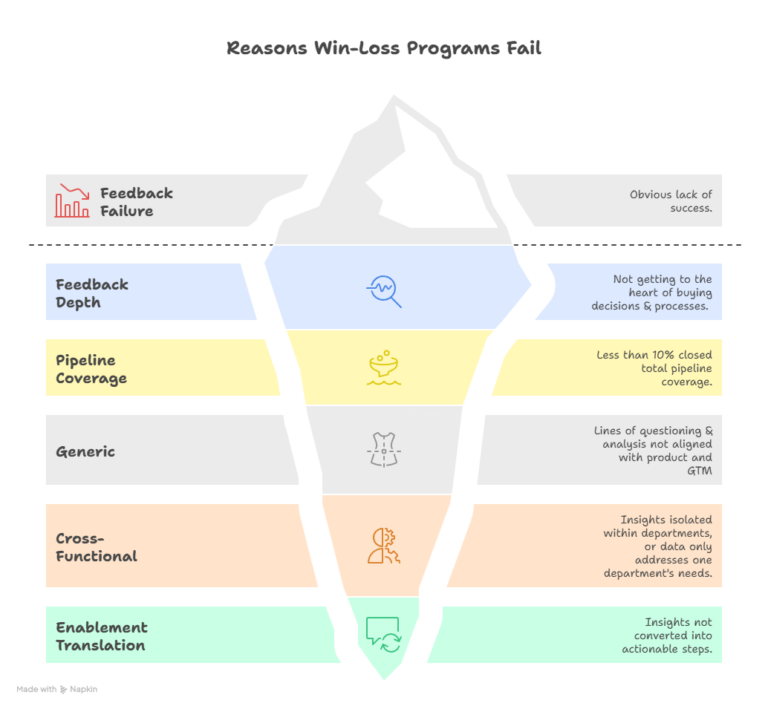
Having any win-loss program at all is a major step in the right direction – but not all win-loss analysis is created equal. So what stops you from executing a successful win-loss program that drives significant value to the business? Here I’ll list the biggest reasons i’ve seen:
- Lack of detail: Interviews are short, surface-level or don’t probe effectively. This is often linked to skill of the interviewer.
- Lack of consistency: Win-loss is only conducted occasionally, or ad-hoc after a big win or loss.
- Lack or data/ poor response rates: Not getting many responses to requests for interviews or surveys (often much more of an issue for closed lost). Getting feedback from 10% of your closed pipeline is the absolute minimum.
- Lack of adaption: Interview questioning not aligned with business pivots and product updates. Interviewing not adapted for different personas or product lines.
Any of the above can lead to a win-loss program that feels fragmented, or it not getting to the ‘core’ of what the business should do to increase win-rates.
I’ve written in a lot more detail about this, and what you can do to set your win-loss program back on the right track, here.
Outsourced vs In-house win-loss
As with most things, deciding whether you should run your win-loss analysis program in-house or outsource it to a third party provider, is a case of your business’s individual circumstances and what makes the most sense for you. Ultimately, it comes down to two things:
- The capacity/ resource available in-house.
- The skill/ expertise available in house.
Let’s look at each of these in-turn:
Capacity
Win-loss is a very labour intensive undertaking, and it needs to be done consistently to see the greatest benefits. I.e. it can’t be picked up and dropped every now and then. You have program setup, outreach and scheduling interviews, collating and writing up the information, checking the accuracy of transcripts (not all win-loss providers do this), and making sure the program itself and lines of questioning are aligned to the business’s changing needs.
With a good win-loss provider you’ll just see results appear in whatever format they’re delivered in (in Clearsighted’s case, they live in our proprietary app). With a not so good win-loss provider you may find chasing interviews or feedback via email is necessary yourself – and this kind of defeats the point of outsourcing in the first place.
Expertise
Conducting high quality in-depth interviews is actually a difficult skill, something that combines critical thinking, adaptability and persuasion. It’s more than reading off a script, or repeating survey questions – it’s creating rapport rapidly with an effective stranger, getting them to open up and be honest with you, probing for detail, or even sometimes pushing back or challenging assumptions. The fact of the matter is that speaking to a knowledge-holder for 45mins-1hr is a very different proposition to a quick, 20 or 30min feedback session.
Vendors should think carefully about whether they truly have this kind of niche expertise, capable of getting to the ‘so whats?’, within the business.
The current win-loss market
Over the past few years, win-loss has gained more attention and recognition among B2B business leaders as a critical practice. If executed well, win-loss is proven to increase revenue and win rates; there are some nice unbiased stats on this from the likes of Gartner (a real win-loss champion) and Accenture.
Win-loss has also become a common topic of discussion at gatherings of Product Marketers, Competitive Intelligence professionals and revenue leaders, at events such as those run by The Alliance. It may be because of this increased scrutiny that there’s been an explosion of win-loss providers and agencies over the past couple of years. A quick look on G2 reveals 32 listings in this area, the largest and most well-known providers being Clozd and Klue. Some of these providers do win-loss, and win-loss alone, while others bundle it in with other packages to do with sales enablement, GTM consulting, competitive intelligence or sales analytics.
As with everything, win-loss outsourcing is a case of ‘horses for courses.’ There’s a helpful article elsewhere on our site that’s a good starting point for selecting a vendor to suit you. There’s also a page on Clearsighted’s unique view of the market and differentiation here.
Conclusion
Navigating the ever-expanding landscape of win-loss providers can be daunting, but one thing’s for certain: every B2B vendor, no matter how large or small, no matter their ICP, should have a win-loss program of some sort. It doesn’t matter whether this is in-house or outsourced, but it does matter that it is delivering value to all functions of your business.
Neglecting win-loss is effectively letting a goldmine of critical information – which can have a real impact on your win-rates and revenue – slip through your fingers.